

Design that wins awards is nice. Design that wins customers pays rent.
Plenty of beautiful websites convert terribly. Visitors land, can't figure out what you do or what to click, and leave — and the analytics call it a "high bounce rate" as if it were weather instead of a design decision.

Design taste is subjective. Conversion isn't.
The problem
Where users look, what they click, where forms lose them — all measurable. Most agencies design for the client's taste and the awards jury. We design for the visitor with a credit card.
The approach
Research before pixels.
Your analytics, session recordings, competitor teardowns, and customer questions come first. The design brief is built from how your buyers actually behave, not a moodboard.
Every page gets one job.
Rank, persuade, or convert. Layout, hierarchy, and copy placement follow that job. When Adkins & Sons' quote form went from eleven fields to four, quote requests jumped — as part of a program that produced 10x pipeline. Friction is a design choice. So is its removal.
UI that builds trust in three seconds.
Visual hierarchy that answers "what is this, is it credible, what do I do next" before the visitor scrolls. Proof elements — reviews, results, logos — placed where doubt actually occurs, not dumped in a footer.
Designed for the whole audience, including machines.
Clean information architecture and semantic structure serve users, Google, and the AI engines that increasingly read your site before humans do. Accessible design (contrast, keyboard navigation, screen-reader sanity) is included, not an upsell.
Design systems, not one-off screens.
Components your developers can build and your team can extend, so page 40 looks as considered as page 1. It's how this site was built — design tokens to components to pages.
Proof
- Adkins & Sons: conversion-first design changes within a program that produced 10x pipeline
- IVM: landing pages rebuilt to single-offer, single-CTA structure as part of its 10x pipeline program
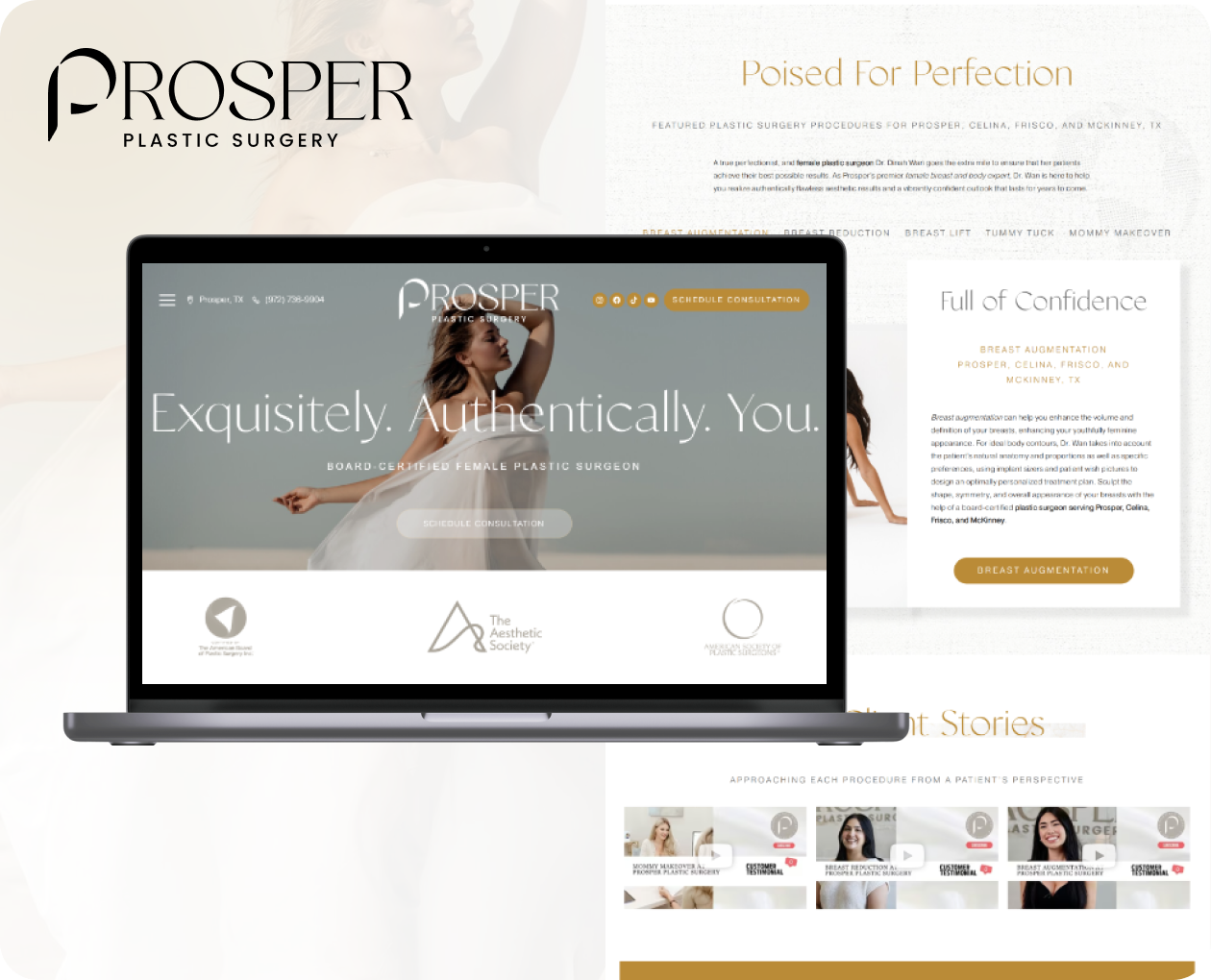
- Portfolio: Bitzel's Chocolates, The Completist, Cabo by Manny, Prosper Plastic Surgery — different industries, same discipline
- 5.0 stars / 45 Google reviews. 5.0 / 14 on Clutch (Premier Verified).
The process
- 1
Research & audit
Week 1
Analytics review, heatmaps/session recordings where available, competitor teardown, conversion leak inventory.
- 2
Architecture & wireframes
Page flows and hierarchy agreed before visual design. Cheap to change here, expensive later.
- 3
Visual design
Brand applied to the conversion skeleton. You review real pages, not abstract style tiles.
- 4
Build handoff or build
Design system documented; our dev team builds it, or yours does with our specs.
- 5
Measure after launch
Conversion rates before and after. If a page underperforms, we iterate — the design isn't finished at the mockup.
What it costs
Design is scoped by page-template count and research depth — a landing page redesign and a full-site design system are different projects. Design pays for itself in conversion lift: a form that converts twice as well halves your effective cost per lead everywhere, forever. Free audit includes what we'd redesign first and why.
Speed is a revenue setting
Conversion rate rises as load time falls — the pattern every rebuild targets. Illustrative of the industry-wide curve.
Illustrative — drawn from published industry studies, not a client claim.
Frequently asked questions
What's the difference between UI and UX design?
UX is the structure: what pages exist, how users move through them, where forms and CTAs sit, why they don't get lost. UI is the surface: typography, color, spacing, the visual credibility of every screen. You need both — a gorgeous site nobody can navigate fails exactly as hard as an ugly, logical one.
How does design actually affect conversion rates?
Directly and measurably. Page speed, visual hierarchy, form length, CTA clarity, and proof placement each move conversion rates. Cut a quote form from eleven fields to four and requests jump. Design isn't decoration on the funnel — at the page level, design IS the funnel.
Do you redesign existing websites or only design new ones?
Both, and redesigns often deliver faster returns because your analytics already show where the leaks are. We audit real behavior first, so the redesign fixes what's provably broken instead of replacing things that worked. Existing rankings and high-converting pages get protected in the process.
Will a redesign hurt my SEO?
Done carelessly, yes — it's one of the most common ways sites lose rankings. Done properly, a redesign helps: better Core Web Vitals, cleaner structure, stronger engagement signals. We map redirects, preserve ranking content, and monitor positions through launch. Protecting search equity is a hard requirement in our process, not a hope.
How long does a website design project take?
A focused landing-page or template redesign runs two to four weeks; full-site design systems run four to eight weeks before development. The honest variables are stakeholder feedback speed and content readiness. We give you a real schedule in the proposal with your dependencies flagged, so nobody's surprised in week three.
Get a free audit, built by a strategist, not a sales rep.
Tell us your site and your goal. Within 2-3 business daysyou'll get a real plan with real numbers: what we'd do, what it costs, what it should return.
No spam, no drip sequence, no 17 follow-up calls. One proposal, from us to you.