

Healthcare marketing: trust engineering under privacy constraints.
Nobody googles a doctor the way they google a plumber. A patient researching a procedure is scared, private about it, and reading everything — your reviews, your credentials, forum threads about you, and now AI summaries of all three.

Your patient is researching you right now. Quietly.
Healthcare marketing is trust engineering under privacy constraints: HIPAA-aware analytics, compliant review handling, and education content that calms before it converts. The patient deciding between you and the practice across town isn't comparing taglines. They're comparing what they found at 11pm in a private browser tab — and whether what they found made the procedure feel survivable.
That changes every tactic. Remarketing that follows a patient around the internet after they visited your vasectomy page isn't clever — it's a compliance incident. A review response that confirms someone was ever your patient is another one. Healthcare rewards the agencies that treat the constraints as the spec, not the obstacle.
A patient who feels sold to closes the tab. A patient who feels informed books the consult.
How patients actually search
- Symptom and condition queries: "is [symptom] serious," "[condition] treatment options" — the research starts weeks before a provider's name ever enters the search bar. The practice that educates first gets vetted first.
- Provider vetting: "best [specialty] near me," "[doctor name] reviews" — patients cross-check your credentials, your reviews, and your response to the bad review before they cross-check your availability.
- Cost and coverage: "[procedure] cost," "does insurance cover [procedure]" — the questions practices avoid answering are the ones patients decide on. Answer them plainly and you win by default.
- AI summaries: patients now ask ChatGPT and Gemini to explain a diagnosis, compare treatment options, and summarize what people say about a practice. Structured, accurate content is what the machines cite.
What we run for healthcare clients
Education content that calms before it converts
Condition and procedure pages written for accuracy and reviewed by your clinicians — structured to rank in Google and get cited in AI answers.
Local SEO for providers
For routine care, patients pick from the map pack. Google Business Profile strategy, location pages, and category work for every provider and office.
Compliant review management
Systematic review generation from real patients — and response playbooks that never confirm anyone was a patient.
HIPAA-aware PPC and analytics
No remarketing pools built on patient behavior, no PHI in your analytics. Conversion tracking configured to measure the marketing, not the patient.
Patient-first web design
Fast, calm, credible sites where the next step is always obvious — built the way we built for Prosper Plastic Surgery.
The agency behind the work
- clients across 5+ years
- 100+
- clients across 5+ years
- stars across 45 Google reviews
- 5.0
- stars across 45 Google reviews
- on Clutch, 16 reviews, Premier Verified
- 5.0
- on Clutch, 16 reviews, Premier Verified
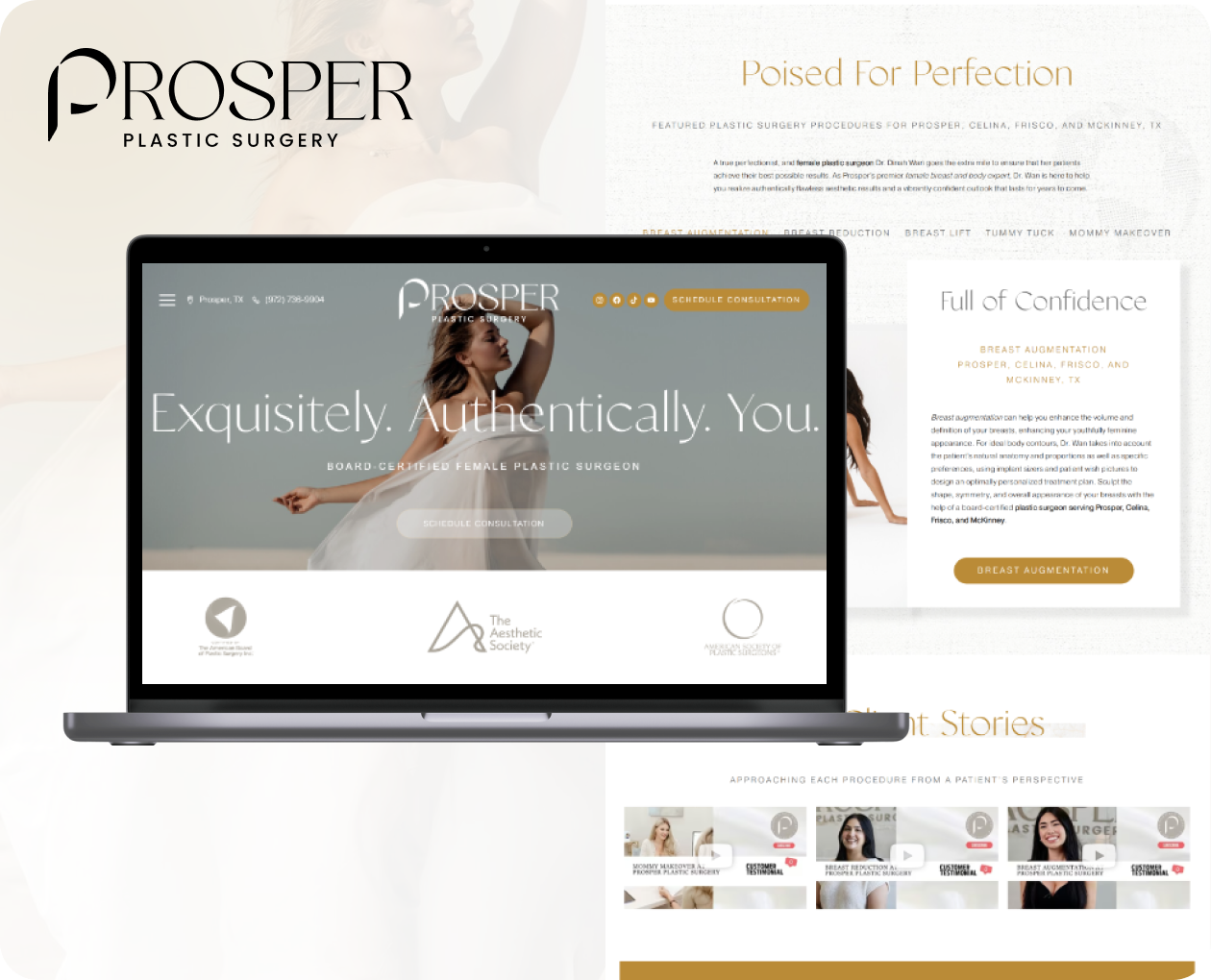
Proof in a sensitive category
Prosper Plastic Surgery sits in our portfolio for a reason: patient-first UX and compliance-aware content handling for one of the most sensitive categories in healthcare. Elective aesthetic procedures are where privacy anxiety and research depth peak at the same time — the build had to earn trust on every scroll.
See the work in the portfolio and the measured outcomes across industries in our case studies.
Every surface that answers your buyers
One consistent, verifiable presence feeds every channel a buyer checks before calling.
Healthcare marketing FAQs
How much should a healthcare practice spend on marketing?
Specialty sets the math. A practice built on high-value elective procedures can justify a very different budget than one built on routine visits, because patient lifetime value differs by an order of magnitude. Established practices invest at levels that vary widely. Our proposal shows the math against your actual patient value, by service line, before you commit a dollar.
How long until we see new patients?
PPC produces consult requests in weeks. Organic is slower here than in most industries: health content sits in Google's highest-scrutiny tier, so rankings are earned through demonstrated expertise, not volume — typically three to six months before compounding starts. We run both channels so the paid bridge covers the organic ramp, and we report by service line, not blended averages.
How do you market a practice without violating HIPAA in tracking and remarketing?
By designing for it upfront. No remarketing audiences built from patient site behavior, no PHI passed to ad platforms or analytics, consent-safe and aggregate conversion tracking only. We treat every page URL, form field, and click as potentially sensitive, because a visit to a condition page is itself health information. You get real marketing measurement; your compliance officer gets a configuration they can defend.
How do we handle negative patient reviews when we legally can't discuss the case?
You respond without confirming the reviewer was ever a patient: acknowledge the concern, state your standards of care in general terms, and offer a private channel. Never dispute facts publicly — that's how a one-star review becomes a HIPAA complaint. Then we outweigh it: systematic review generation from satisfied patients makes any single negative statistically honest instead of defining.
Who writes the medical content — and who's accountable for its accuracy?
We draft, your clinicians review, and the byline carries their credentials. That's not just liability hygiene — Google holds health content to elevated quality standards, and credentialed authorship is part of how pages rank. Content published under a real physician's name, reviewed for accuracy, beats anonymous SEO copy in this category every time.
Get a free audit, built by a strategist, not a sales rep.
Tell us your site and your goal. Within 2-3 business daysyou'll get a real plan with real numbers: what we'd do, what it costs, what it should return.
No spam, no drip sequence, no 17 follow-up calls. One proposal, from us to you.