

Automotive marketing is two funnels. Most dealers run them as one blur.
Car buyers walk into the dealership already decided — the average shopper spends about 14 hours researching online and visits fewer than two lots. Meanwhile your service department lives in a different universe entirely: "brake repair near me," today, from a phone.

The considered purchase and the urgent repair don't mix
The sales funnel is long and comparison-heavy: inventory searches, model-vs-model queries, financing math, review deep-dives — spread over weeks and increasingly filtered through AI assistants and the big aggregators. The service funnel is the opposite: urgent, local, and won or lost in the map pack within the hour.
Running one campaign, one budget, and one landing page for both is how dealer marketing turns into a blur that wins neither. We split them: distinct strategies, distinct budgets, distinct measurement — because a sold unit and a booked brake job have nothing in common except your logo.
The buyer spends weeks deciding. The repair customer decides in minutes. Run one funnel for both and you lose both.
How automotive customers actually search
Sales side: "[model] vs [model]," "best used SUV under $30K," "[dealer] reviews," "[model] lease deals" — plus Cars.com, CarGurus, and Autotrader sitting on the head terms, and AI assistants now doing the first comparison pass. You beat the aggregators with what they can't have: your inventory pages structured to rank, your local reputation, and your financing answers.
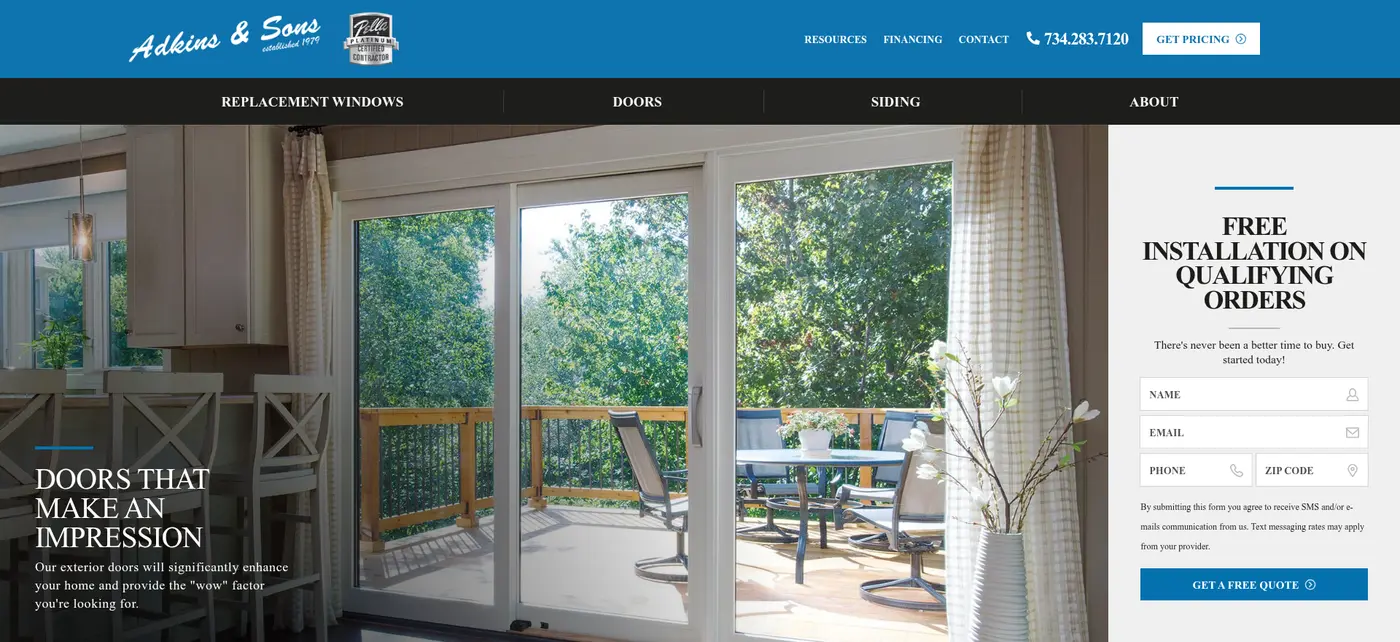
Service side: "transmission repair near me," "oil change [city]," "dealership service vs independent." Pure local-pack mechanics — Google Business Profile, review velocity, service pages per job type. It's the exact system that took Adkins & Sons from invisible to the top of the local pack across their service area.
What we run for automotive clients
Local SEO (service funnel)
Map-pack dominance for every service line: GBP, reviews, per-service pages, citation cleanup. → Local SEO
Inventory & comparison SEO
Model pages, comparison content, and financing answers structured to rank against the aggregators. → SEO Services
PPC, two budgets
High-intent sales terms geofenced to your market, and always-on service campaigns that fill the bays. → PPC
Reputation management
Review generation and response across sales and service — the first thing every buyer checks. → Reputation Management
Conversion-first web development
Click-to-call, service booking, financing pre-qual, inventory UX — built for phones, where automotive decisions happen. → Website Development
The agency behind the work
- quote requests (Adkins & Sons, local-service funnel)
- 10x
- quote requests (Adkins & Sons, local-service funnel)
- pipeline (IVM — wasted ad spend eliminated)
- 10x
- pipeline (IVM — wasted ad spend eliminated)
- on Google across 45 reviews
- 5.0
- on Google across 45 reviews
Proof on both halves of the playbook
The two-funnel playbook is proven on both sides: Adkins & Sons Windows on the considered local purchase — 10x quote requests per month — and IVM Inc. on paid-spend discipline, where fixing broken tracking and killing wasted spend produced 10x pipeline.
Every surface that answers your buyers
One consistent, verifiable presence feeds every channel a buyer checks before calling.
Automotive marketing FAQs
How do we compete with Cars.com, CarGurus, and Autotrader for buyers researching inventory?
You don't outrank them on "used cars near me" — you flank them. Aggregators can't own your dealership's reputation, your service relationship, or long-tail specifics: "[model] [trim] [city]," "[model] financing bad credit," "[dealer] vs [dealer]." Structured inventory data (vehicle schema) gets your actual cars into rich results and AI answers. And every aggregator lead still checks your reviews before driving over — which is why reputation is part of the sales funnel, not a side project.
Should the service department have its own marketing budget separate from sales?
Yes, and this is the highest-leverage structural change most dealers can make. Service customers search urgently and locally — map pack, reviews, click-to-call — while sales campaigns chase a weeks-long consideration cycle. Blended budgets invariably starve service, even though service revenue is steadier and the local-pack work compounds. Separate budgets also make measurement honest: booked ROs and sold units get their own cost-per-acquisition, and the blur disappears.
Car buyers ask AI assistants for recommendations now. Does that change anything?
It changes the first mile. "What's the most reliable 3-row SUV under $40K" now gets answered by an assistant assembling specs, reviews, and dealer reputation before a buyer ever hits a search results page. Dealers show up in that answer through structured inventory data, consistent entity information, and citable content — honest comparison and financing answers, not brochure copy. It's the same GEO discipline we run in every category, pointed at automotive queries.
How fast can local service marketing produce booked appointments?
Fastest of anything in automotive. Service PPC on urgent queries produces calls in the first weeks; map-pack gains from GBP optimization and review velocity typically move within 60–90 days. That speed is the strategic point: service wins fund the patience the sales funnel needs, where inventory SEO and comparison content build over quarters. The roadmap sequences it exactly that way — quick service wins first, compounding sales visibility behind it.
We're an independent repair shop, not a dealership. Does this apply to us?
Directly — you're running the service funnel without the sales-side distraction, which simplifies everything. Your war is the local pack: per-service pages (brakes, transmission, diagnostics), Google Business Profile discipline, review generation that outpaces the shop across town, and "dealership vs independent" content that converts the cost-conscious. It's the same local system that put Adkins & Sons at the top of the local pack across their service area, pointed at auto repair.
Get a free audit, built by a strategist, not a sales rep.
Tell us your site and your goal. Within 2-3 business daysyou'll get a real plan with real numbers: what we'd do, what it costs, what it should return.
No spam, no drip sequence, no 17 follow-up calls. One proposal, from us to you.